

Hello and welcome to this Track of Words guest post, where today I’m joined by author James Gill with an excellent article about running Kickstarter campaigns for adventure gamebooks. At the time of writing James’ latest campaign is currently running, for Tentacles of the Void (which looks amazing!), and we thought it would be interesting to take a look at what James has learned over the course of running two campaigns. So without further ado, over to James.
***
James Gill: My name’s Gill, and along with my old friend James Isaacs, I run Hammerforge Chronicles, a tiny independent publisher making traditional, illustrated adventure gamebooks. We met working at Metal Hammer magazine back in 2005 and discovered a shared enthusiasm for Fighting Fantasy, Games Workshop, science fiction, fantasy and heavy metal. Twenty years later, we decided to make our own gamebook.
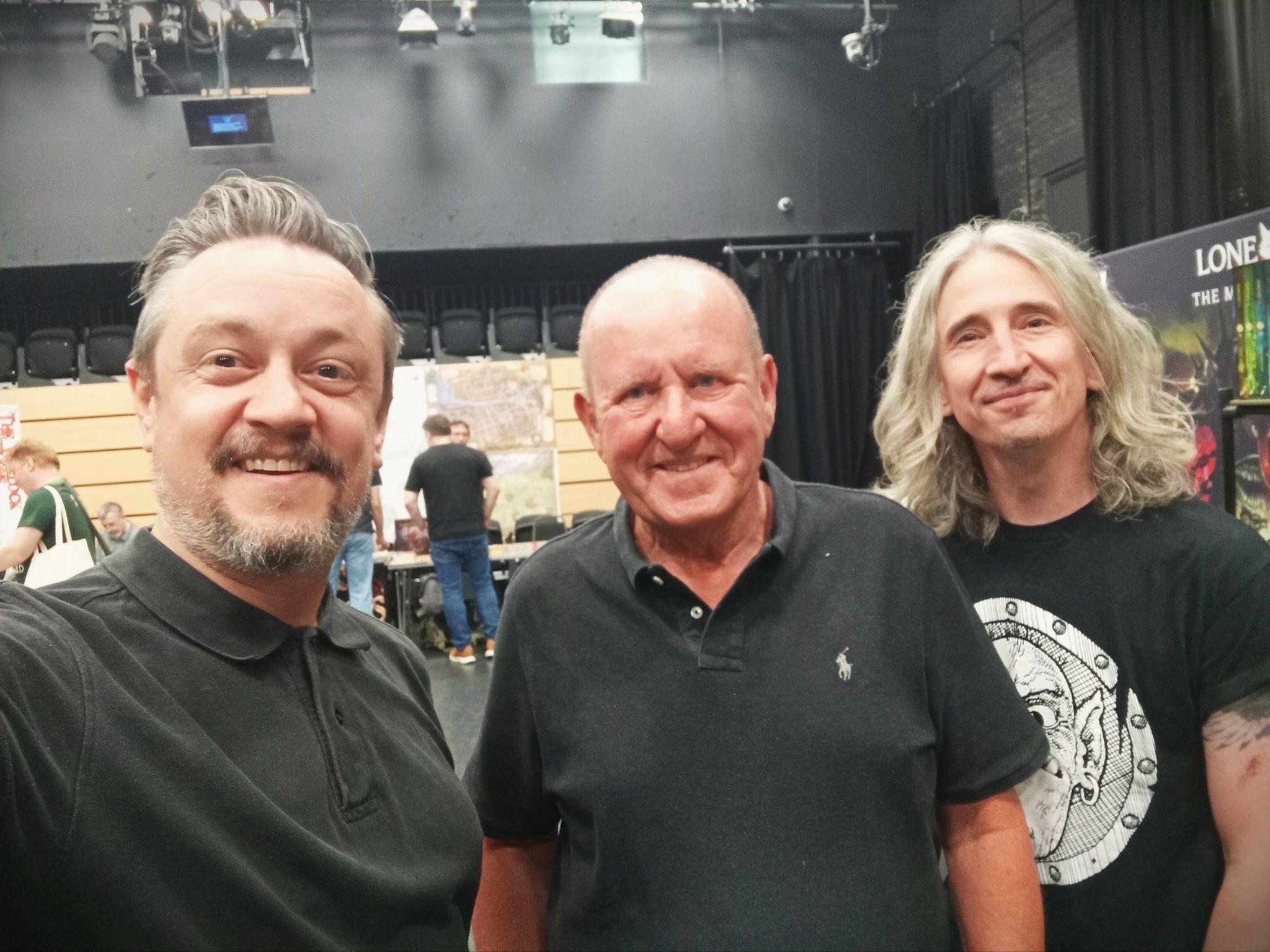
Gill (left) with Sir Ian Livingstone and James Isaacs.
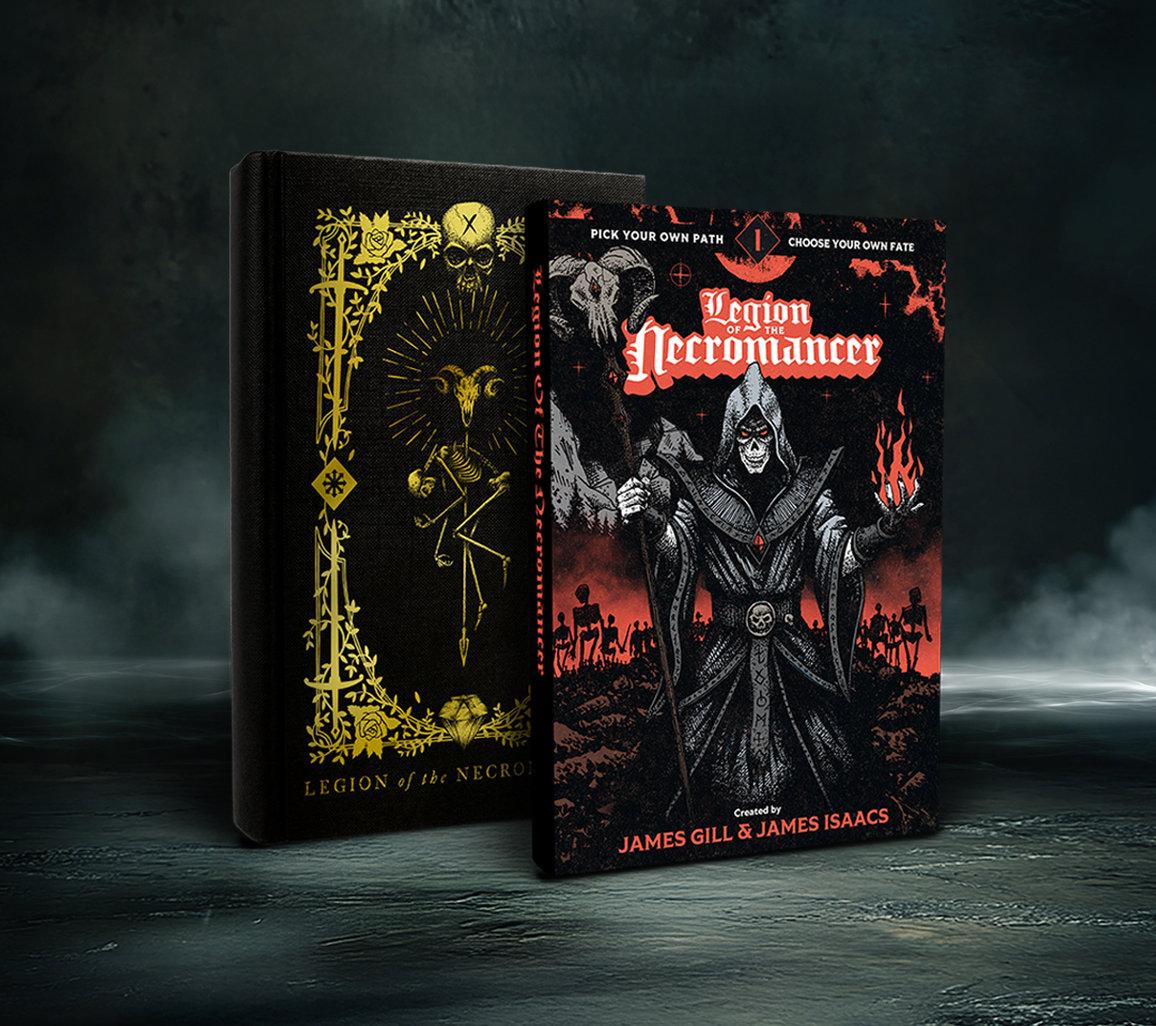
Our first, Legion of the Necromancer, launched on Kickstarter in October 2025. It funded within 24 hours and eventually raised £10,435 from 327 backers. A year later, we launched our second, Tentacles of the Void, which reached its £3,000 target in just six hours. Which all sounds rather straightforward when I put it like that.
Behind it all was plenty of work, head-scratching and some spectacularly unglamorous logistics. After two campaigns, one fulfilled book and far too much time learning about international postage, we’ve picked up a few useful lessons. Here are nine of them.
1. Know exactly who you’re making the thing for
We didn’t really need to invent customer personas or commission market research. We knew the audience because we were the audience. We’d grown up reading Fighting Fantasy, poring over Games Workshop artwork and making terrible decisions in imaginary worlds. And we knew exactly what we wanted from a gamebook: proper characters, rich descriptions, difficult choices, loads of illustrations and the sense that you were exploring a real place.
For me, a good gamebook is a novel that you’re steering, rather than a game in a book. So we set out to make the sort of thing we’d have loved to buy ourselves. And, as it turns out, there were plenty of other people who felt much the same.
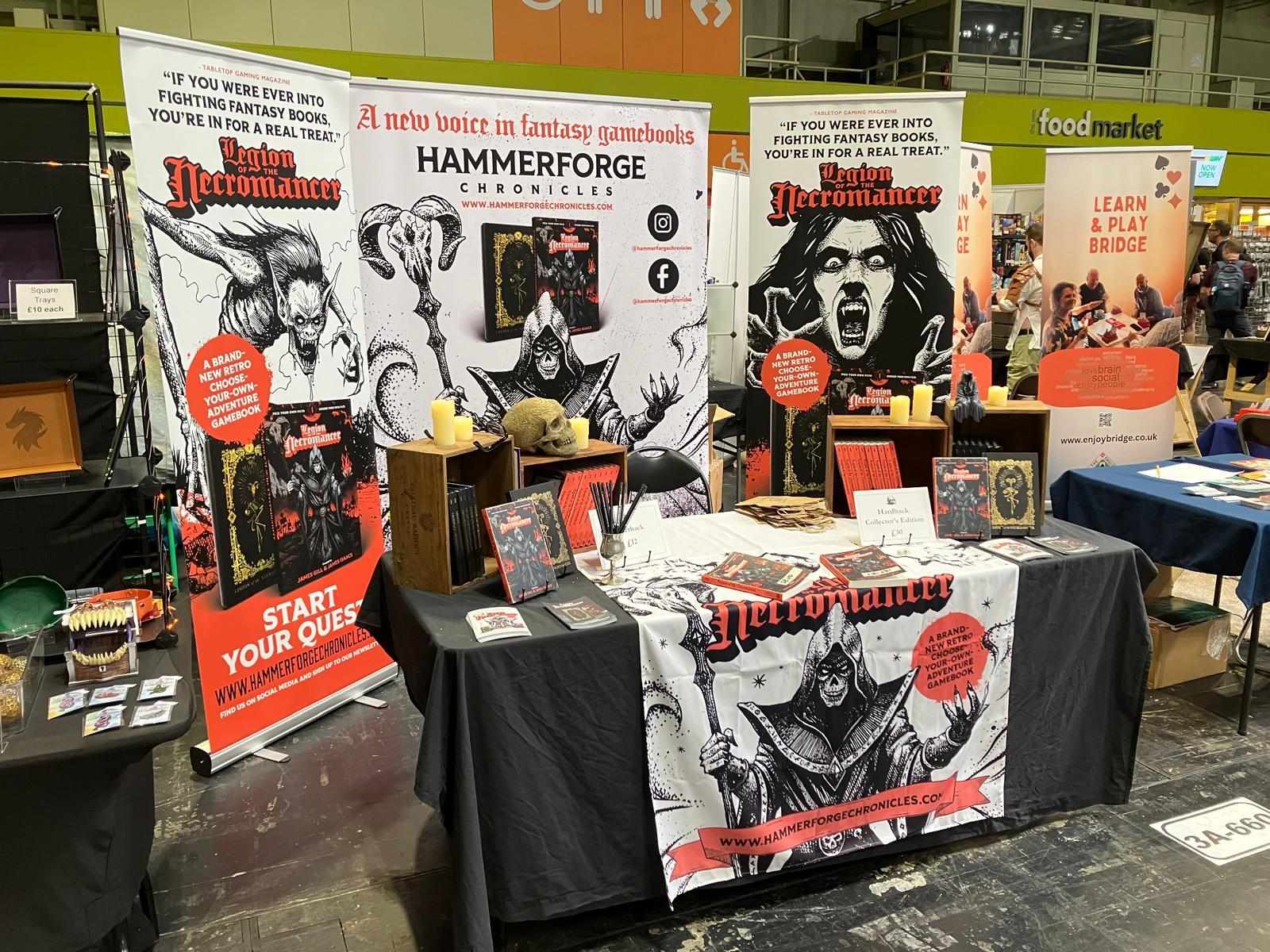
At UK Games Expo, I made eye contact with a bloke walking past our stand. He was about 45, with grey in his beard and a rock-band T-shirt. In other words, he was another me. I held out a copy of Legion and asked, “Did you ever read Fighting Fantasy books back in the day?”
“You saw me coming a mile off, didn’t you?” he said.
He had a point. We’d made a book for people like us, and here was one walking past. That’s the advantage of a niche: you can care about the daft little details that matter to your people.
You still have to find those people, of course.
2. Make something people are excited to own
James and I wanted the books to be lovely things to own. James draws every illustration by hand, in pen and ink. A full-page drawing can take him an entire day. Then there’s all the fussing over paper, binding, typography, covers and foil finishes.
For Legion, we made a fabric-bound hardback with gold foil. Tentacles will have a green-foil edition. We spend a ridiculous amount of time on details like that, because we know what it feels like to pick up a book and immediately want to own it.

At events, people notice. They flick through Legion and tell us how much they appreciate James’s illustrations and the quality of the book. Which is lovely, obviously. But it also tells us that all that extra effort is worthwhile.
If you’re asking someone to back a physical product, give them something they’ll be proud to have on their shelf.
3. Get as much done as possible before you launch
By the time we launched Tentacles, we’d already spent the best part of a year working on it. Both our gamebooks contain 400 numbered sections, which means writing one involves a peculiar mixture of storytelling, mapping, game design and occasionally discovering that two perfectly innocent decisions have created an enormous logical problem.
I map the whole thing in Google Slides, with colour-coded routes, dependencies and connections.

Then comes playtesting, rewriting, illustration and design.
When we launched Tentacles, the manuscript was finished and playtested. We had the cover, sample illustrations and a pretty clear idea of how the finished book would look. Backers could see what they were getting, while we understood the remaining work, costs and timescales.
Once Kickstarter goes live, you’re answering questions, making videos, writing updates, promoting the campaign and checking the funding total far too often. So do as much as you can beforehand. You’ll have quite enough to worry about once it’s live.
4. Kickstarter is a marketplace, so treat it like one
When we launched Legion, we did what seemed sensible and started telling everyone we could about it. Reddit, Facebook, YouTube, reviewers, friends, work contacts etc. But one of the most useful things we’ve learned is that Kickstarter already has an audience. People who actively browse the platform looking for interesting projects, many of whom are particularly fond of niche oddities like ours.
That was reflected in the referral breakdown: Kickstarter attributed more than half our pledges to its own emails, discovery pages, recommendations and search. We’d sometimes see a bump after a social post or an email, but the funding graph otherwise climbed fairly steadily. It suggested a regular stream of people browsing the platform and finding our odd little book. That’s quite a significant advantage.
That means your campaign page must work hard. Artwork, rewards, video and story should quickly explain what you’re making and why someone should back it.
We still promote our books wherever we can, but we’ve become much more interested in getting the right people onto the campaign page and giving them a good reason to back.
Someone who wants a lovingly illustrated, 400-section gamebook can be quite difficult to find in the wider world. On Kickstarter, there’s a decent chance they’ve already backed three.
5. People buy into the people making the thing
Our ‘About us’ is simple: I write the books, James illustrates them and, between our day jobs, we spend time discussing monsters and the correct shade of foil for a hardback.
But when somebody pledges to a Kickstarter, they’re handing over money for something they won’t receive for months. It’s reasonable to want to know who’s taking the money and whether they have any idea what they’re doing. So we get in front of the camera, explain the story and rules, show James’s artwork and occasionally get carried away.
I couldn’t tell you how many pledges a video of the two of us has generated. But people can see who’s making the books, why we care and who’ll have to answer the awkward questions if something goes wrong.
Which will be us, obviously.

6. The first Kickstarter helps sell the second
There’s one fairly obvious advantage to launching your second Kickstarter: this time you’ve actually got a first Kickstarter to point at.
For Legion, people had to take our word for it. For Tentacles, we could show them the finished Legion hardback and reader reviews. We’d done what we’d promised, and that gave people a good reason to trust us.
We also had 327 people who’d backed us once already. So when Tentacles went live, we sent them an update. Essentially: “Thanks for helping us raise the dead. We’ve now gone and filled a spaceship with horrible aliens. Fancy coming along again?”
And lots of them did. We saw a lovely burst of pledges following the update, and the second campaign reached its funding target in six hours, compared with 24 hours for the first. Other factors played a part, but a finished book, happy customers and an existing audience helped enormously.
So if you’re planning more than one Kickstarter, look after your first backers. You’ll be seeing some of them again. Hopefully.
7. Advertising doesn’t always justify the effort
Ah, Facebook advertising. For Legion, we tried Meta ads: writing copy, making artwork, running campaigns, tweaking them and checking the numbers. They just about washed their face. And that’s before we put a price on the hours we’d spent making them.
We also couldn’t establish what they’d actually contributed. Kickstarter’s dashboard didn’t clearly separate paid from organic activity, so it was difficult to know whether the ads were generating pledges or reaching people who’d have found us anyway.
So for Tentacles, we skipped them.
And here’s the interesting bit. The funding graph looks remarkably like the first one. We funded faster, and the curve has much the same shape. Different books, different circumstances and plenty of other variables, obviously, but we haven’t exactly been left wondering where all those Facebook pledges went.
My theory? Meta advertising is better at “That looks nice, I’ll buy it” than “That looks nice, I’ll pledge now and receive it in three months.” That’s quite a journey to ask someone to make from a picture on their phone.
Maybe other creators get great results. For us, the return didn’t justify the effort, so we spent the time doing other things. Like making the books.
8. Small communities are a big advantage
The gamebook community has been wonderfully generous to us. It’s a small world. We’ve got to know reviewers, YouTubers and fellow creators who are every bit as obsessed with gamebooks as we are.
We’ve also been keen to support other creators. Our mate James Hoare makes Secret Passages, which is exactly the sort of wonderfully niche thing we’d buy ourselves. And I’ve been making videos with Michael J Ward, the creator of DestinyQuest, talking about the peculiar business of writing gamebooks.
My hunch is that relevance matters much more than raw audience size. Someone with a few thousand followers who are all into Fighting Fantasy could be far more useful to us than a gaming account followed by half a million people who’ve never rolled a SKILL test.
For a small publisher, becoming part of that community is one of the best things you can do. It helps the books find their people. And you usually make some friends along the way.
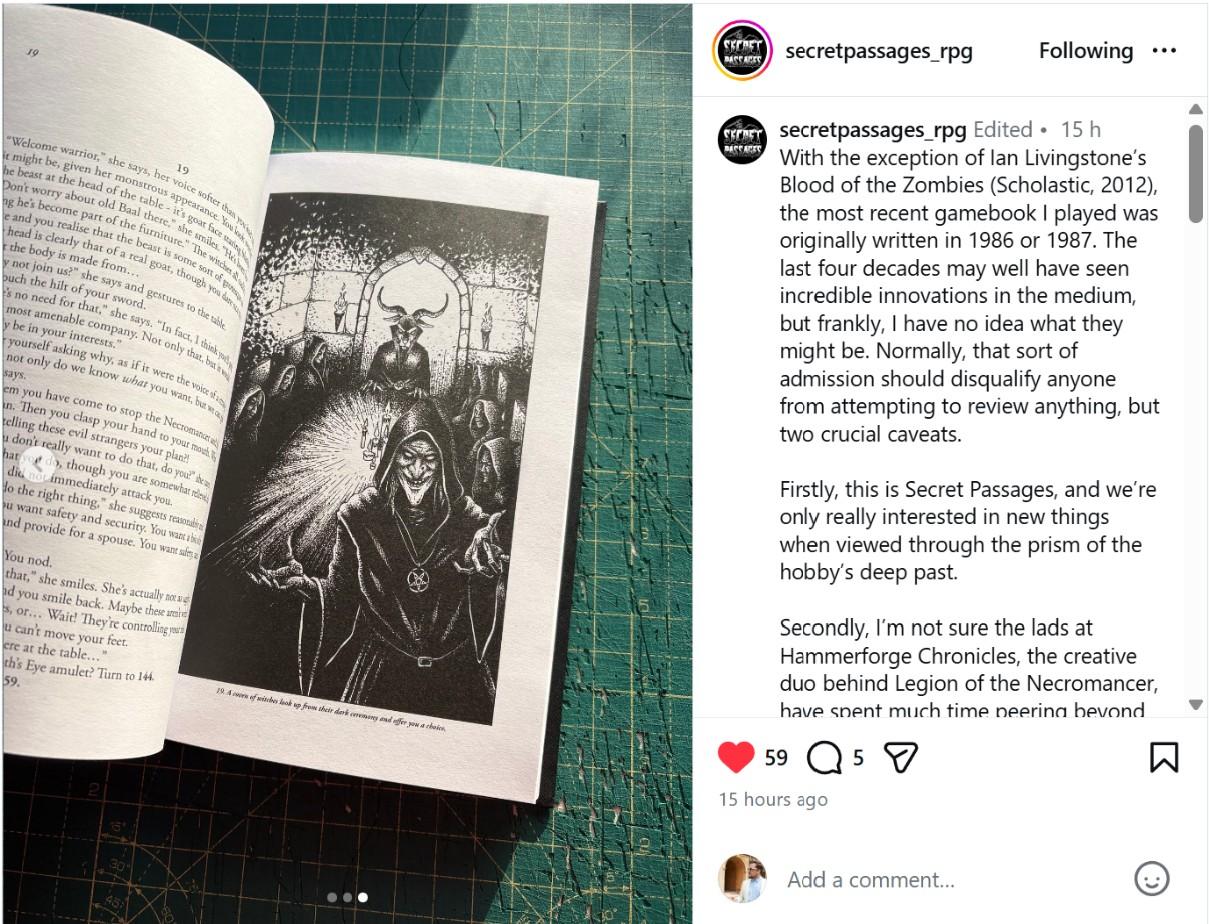
I can heartily recommend Secret Passages too, by the way. I even have book reviews included in the first two issues!
9. Getting funded is the easy bit. Then you have to make and send the bloody things.
There’s a wonderful moment when Kickstarter tells you you’ve hit your target. People want the book. They’ve given you money. You feel very pleased with yourself. Then you remember you’ve got to make hundreds of them and put them in the post.
Fortunately, James has years of experience as a magazine publisher and designer. He handled everything on the printing side, which made life a lot easier for us. The postage, however, was another matter.
For Legion, this meant learning far more about packaging, weights, customs codes and international postage than either of us had ever wanted to know. At one point, sending a £12 paperback to the US was going to cost around £17. Which is a slightly alarming conversation to have with somebody who’s already paid for the book.
Then there’s printing, fees, packing materials, rewards and sketches. The big number on your Kickstarter page looks different once you subtract the costs. Especially if you make the mistake of putting a value on your own time.
Fulfilling Legion gave us real costs and a better grasp of the workload, making Tentacles easier to plan and problems easier to spot.
So work out the fulfilment costs before you launch, and give yourself some breathing room. Otherwise, you could end up with a hugely successful Kickstarter and a slightly less successful bank balance.

So, what have we actually learned?
One and a half Kickstarters in, I wouldn’t claim we’ve cracked it.
What has surprised me most is that people really do want the sort of book James and I set out to make. Proper stories, lots of illustrations and physical editions that feel awesome in your hand and look beautiful on the shelf.
The bloke who told me “You saw me coming a mile off” was right. We were making books for people like him. And ourselves. There seem to be rather more of us than we’d dared hope.
Whether any of this is a sensible way for two people with day jobs to spend their evenings is another question. We’ve already started work on book three. So I suppose that tells you something.
***
Gill is the writing half of Hammerforge Chronicles, the tiny independent UK gamebook publisher he runs with illustrator and designer James Isaacs. Their first book, Legion of the Necromancer, was funded on Kickstarter in October 2025 and fulfilled in January 2026. Their second, Tentacles of the Void, reached its funding target in just six hours in October 2026.
Find out more on the Hammerforge Chronicles website.
***
Thanks so much to (James) Gill for taking the time to write such a fascinating article – I hope, like me, you enjoyed this peek behind the scenes of running Kickstarter campaigns for gamebooks! And if this has piqued your interest in Tentacles of the Void, please make sure you pledge to the campaign on Kickstarter!

Click the image above to check out the Kickstarter campaign.
And if you enjoyed this article and would like to support Track of Words, you can leave me a tip on my Ko-Fi page.
